
A boom lift is rated for 20 m of working height and 12 m of horizontal outreach. Your job requires access at 18 m high and 10 m away from the machine. Will it reach?
Those two maximum figures do not necessarily occur at the same boom position. The answer is in the manufacturer’s working-envelope—or reach—chart, for the specified load and machine configuration.
What a reach chart actually shows
In a typical chart, the vertical axis gives height and the horizontal axis gives reach from a stated reference point. The bounded area represents allowable platform positions. Before reading the graph, establish three things:
Height reference: Is the vertical axis platform height or working height? The two must not be substituted for one another.Horizontal reference: Is distance measured from the slew centre, a stated chassis point or another datum? Do not use “front tyre to wall” unless the drawing says so.Operating conditions: Does the envelope depend on load, boom configuration or other restrictions?
Figure: How to read a boom-lift reach diagram. The accompanying original schematic is an explanatory drawing, not an operating chart for a real machine. For a manufacturer example with separate platform-capacity zones, see the JLG 800AJ HC3 reach chart, section 4.3 of its operation manual.
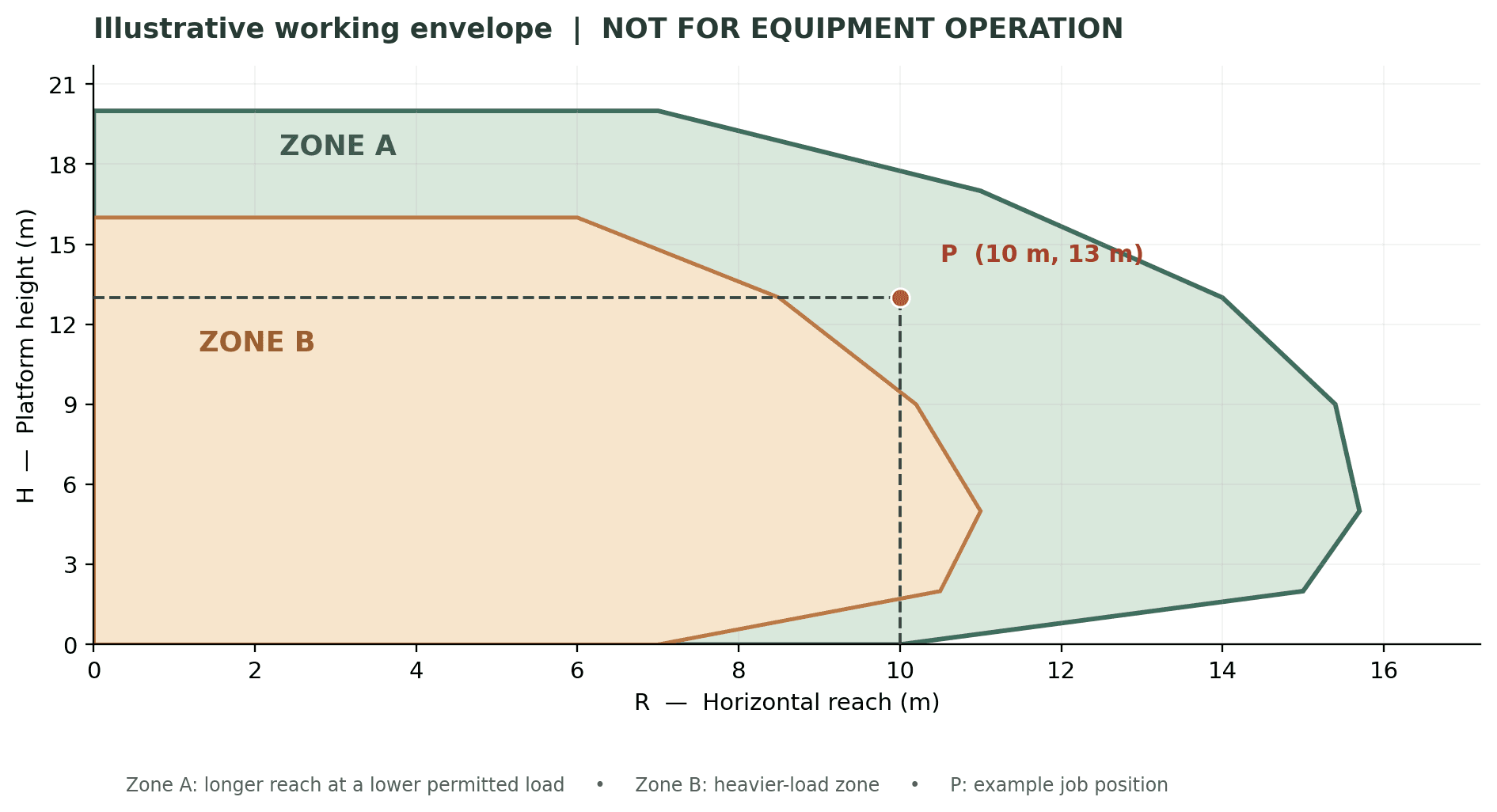
Educational schematic only. Zones A/B illustrate different load limits; never use this drawing to operate equipment.
Plot the job, not the brochure maximum
Measure the proposed machine position and the actual platform position required to complete the task. Convert both measurements to the reference used by the manufacturer’s chart. Mark the required height and horizontal reach. Their intersection must fall inside the correct load-rated zone.
The following numbers are an illustration, not data for a particular model:
| At the required platform position | Boom A | Boom B |
|---|---|---|
| Advertised maximum working height | 20 m | 20 m |
| Advertised maximum horizontal outreach | 12 m | 14 m |
| Reach available at the required height and load | 8 m | 11 m |
| Required reach | 10 m | 10 m |
| First assessment | Does not reach | Potentially suitable |
Boom A fails even though its headline height and outreach each sound sufficient.
Load can change the available envelope
Some machines allow a smaller reach envelope at higher platform loads. The JLG 800AJ HC3 chart, for example, distinguishes 454 kg, 340 kg and 300 kg platform-capacity zones. These are manufacturer-specific limits; they must not be applied to another model. JLG operation manual, reach chart.
Calculate the total of people, tools and materials, then use the zone that permits that load. “Maximum platform capacity: 454 kg” does not mean 454 kg is allowed everywhere in the chart.
A reachable point may still be obstructed
A chart is not a collision study. The platform may be able to reach a point while the boom cannot travel there without hitting an eave, pipe rack or façade. A knuckle boom may offer useful up-and-over movement, while a telescopic boom may provide more direct outreach; neither is automatically suitable. Check the entire movement path, tail swing, chassis position, ground support, wind and levelling restrictions.
Ask for the drawing with your target marked
Maximum height tells you where a boom lift can reach at its highest. The envelope tells you whether it can reach where your job actually is.
See the guide to tracked spider and towable boom lifts for the relevant checks.